⬇️ Download profile metadata (JSON-LD)  |  ⬇️ Download profile metadata (Excel)

Language Data Commons RO-Crate Profile

LDaCA Website →

This document is a DRAFT RO-Crate profile for Language Data resources. The profile specifies the contents of RO-Crate Metadata Documents for language resources and gives guidance on how to structure language data collections both at the RO-Crate package level and in a repository containing multiple packages.

This profile assumes that the principles and standards set out in the PILARS protocols, or similar compatible approaches, are being used.

The core metadata vocabularies for this profile are:


Audience

This document is primarily for use by tool developers, data scientists and metadata specialists developing scripts or systems for user communities. It is not intended for use by non-specialists.

Just as we would not expect repository users to type Dublin Core metadata in XML format by hand, we do not expect our users to have to deal directly with the JSON-LD presented here. This document is for tool developers to build systems that crosswalk data from existing systems, or allow for user-friendly data entry.


About this Profile

This profile covers various kinds of crate metadata:


Structural Metadata

The structural elements of a Language Data Commons RO-Crate are:

NOTE: The terms Collection and Object are encoded in RO-Crate metadata using RepositoryCollection and RepositoryObject types respectively. These in turn are re-named versions of the Portland Common Data Model types, pcdm:Collection and pcdm:Object.

A conformant RO-Crate:

Class: Dataset

A body of structured information describing some topic(s) of interest.

Instances of this type MAY be present in the crate.

Min Count Max Count
N/A N/A
Property Specialization Of Required Description Range Value
@type Yes Dataset
accountablePerson http://schema.org/accountablePerson Yes The person or organisation who is the data steward for this resource. Person, Organization
author http://schema.org/author Yes The person or organisation responsible for creating this collection of data. Authors should be identified using URIs such as ORCiD or ROR. Person, Organization
publisher http://schema.org/publisher Yes The organisation responsible for releasing this dataset. Organization
dct:rightsHolder http://purl.org/dc/terms/rightsHolder Yes The person or organisation owning or managing rights over the resource. Text, Person, Organization
ldac:annotationOf https://w3id.org/ldac/terms#annotationOf No This resource contains some kind of description that adds information to the resource it references. Primary Material
ldac:annotator https://w3id.org/ldac/terms#annotator No The participant produced an annotation of this or a related resource. Person, Organization
citation http://schema.org/citation No Associated publications. Creative Work
ldac:compiler https://w3id.org/ldac/terms#compiler No The participant is responsible for collecting the sub-parts of the resource together. Person, Organization
ldac:consultant https://w3id.org/ldac/terms#consultant No The participant contributes expertise to the creation of a work, for example by contributing knowledge of their native language. Person, Organization
creditText http://schema.org/creditText No A free text bibliographic citation for this material, e.g. 'Cite as: Musgrave (2023). Title of work. DOI'. Text
ldac:dataInputter https://w3id.org/ldac/terms#dataInputter No The participant responsible for entering, re-typing, and/or structuring the data contained in the resource. Person, Organization
ldac:depositor https://w3id.org/ldac/terms#depositor No The participant responsible for depositing the resource in an archive. Person, Organization
ldac:developer https://w3id.org/ldac/terms#developer No The participant developed the methodology or tools (including software) that constitute the resource, or that were used to create the resource. Person, Organization
ldac:doi https://w3id.org/ldac/terms#doi No A Digital Object Identifier, e.g. https://doi.org/10.1000/182. Text
ldac:editor https://w3id.org/ldac/terms#editor No The participant reviewed, corrected, and/or tested the resource. Person, Organization
funder http://schema.org/funder No The organisation(s) responsible for funding the creation or collection of this dataset. Organization
ldac:hasCollectionProtocol https://w3id.org/ldac/terms#hasCollectionProtocol No A link to a CollectionProtocol object with (at least) a summary of how resources were selected or elicited for this collection/sub-collection. Collection Protocol
pcdm:hasMember http://pcdm.org/models#hasMember No The sub-collections, if any, associated with this collection. Repository Collection, Repository Object
hasPart http://schema.org/hasPart No An item or CreativeWork that is part of this item, or CreativeWork (in some sense). Creative Work, File, Dataset
ldac:illustrator https://w3id.org/ldac/terms#illustrator No The participant contributed drawings or other illustrations to the resource. Person, Organization
ldac:interpreter https://w3id.org/ldac/terms#interpreter No The contributor renders the discourse recorded in the resource into another language in real time, or the contributor explains the discourse recorded in the resource. Person, Organization
ldac:interviewee https://w3id.org/ldac/terms#interviewee No The participant was a respondent in an interview. Person, Organization
ldac:interviewer https://w3id.org/ldac/terms#interviewer No The participant conducted an interview that forms part of the resource. Person, Organization
isAccessibleForFree http://schema.org/isAccessibleForFree No This is available under an Open Access license. Boolean
isBasedOn http://schema.org/isBasedOn No Link to or description of an original resource. Text, URL, Creative Work, Dataset, File
isPartOf http://schema.org/isPartOf No An item or CreativeWork that this item, or CreativeWork (in some sense), is part of. URL, Creative Work
pcdm:memberOf http://pcdm.org/models#memberOf No Links from a Repository Object or Collection to a containing Repository Object or Collection. Repository Collection
ldac:participant https://w3id.org/ldac/terms#participant No The participant was present during the creation of the resource, but did not contribute substantially to its content. Person, Organization
ldac:performer https://w3id.org/ldac/terms#performer No The participant performed some portion of a recorded, filmed, or transcribed resource. It is recommended that this term be used only for creative participants whose role is not better indicated by a more specific term, such as 'speaker', 'signer', or 'singer'. Person, Organization
ldac:photographer https://w3id.org/ldac/terms#photographer No The participant took the photograph, or shot the film, that appears in or constitutes the resource. Person, Organization
ldac:recorder https://w3id.org/ldac/terms#recorder No The participant operated the recording machinery used to create the resource. Person, Organization
ldac:researchParticipant https://w3id.org/ldac/terms#researchParticipant No The participant acted as a research subject or responded to a questionnaire, the results of which study form the basis of the resource. Person, Organization
ldac:researcher https://w3id.org/ldac/terms#researcher No The resource was created as part of the participant's research, or the research presents interim or final results from the participant's research. Person, Organization
ldac:responder https://w3id.org/ldac/terms#responder No The participant was an interlocutor in some sort of discourse event, but only reacted to the contributions of others. Person, Organization
ldac:signer https://w3id.org/ldac/terms#signer No The contributor was a principal signer in a resource that consists of a recording, a film, or a transcription of a recorded resource. Signers are those whose gestures predominate in a recorded or filmed resource. (The resource may be a transcription of that recording). Person, Organization
ldac:singer https://w3id.org/ldac/terms#singer No The participant sang, either individually or as part of a group, in a resource that consists of a recording, a film, or a transcription of a recorded resource. Person, Organization
spatialCoverage http://schema.org/spatialCoverage No The place(s) that are the focus of the content. It is a sub-property of contentLocation intended primarily for more technical and detailed materials. For example, with a dataset, it indicates areas that the dataset describes: a dataset Cape York languages would have spatialCoverage which was the place: the outline of the Cape. Place
ldac:speaker https://w3id.org/ldac/terms#speaker No The contributor was a principal speaker in a resource that consists of a recording, a film, or a transcription of a recorded resource. Speakers are those whose voices predominate in a recorded or filmed resource. (The resource may be a transcription of that recording). Person, Organization
ldac:sponsor https://w3id.org/ldac/terms#sponsor No The participant contributed financial support to the creation of the resource. Person, Organization
temporalCoverage http://schema.org/temporalCoverage No The range of years of creation for items in this dataset using a slash, e.g. 1900/1945. If there are sub-collections with different coverages put this on the sub-collections not the top-level. DateTime, Text
ldac:transcriber https://w3id.org/ldac/terms#transcriber No The participant produced a transcription of this or a related resource. Person, Organization
ldac:translator https://w3id.org/ldac/terms#translator No The participant produced a translation of this or a related resource. Person, Organization
usageInfo http://schema.org/usageInfo No Additional information on licensing options for using the data, e.g. 'Contact the Data Steward to discuss license terms'. Text

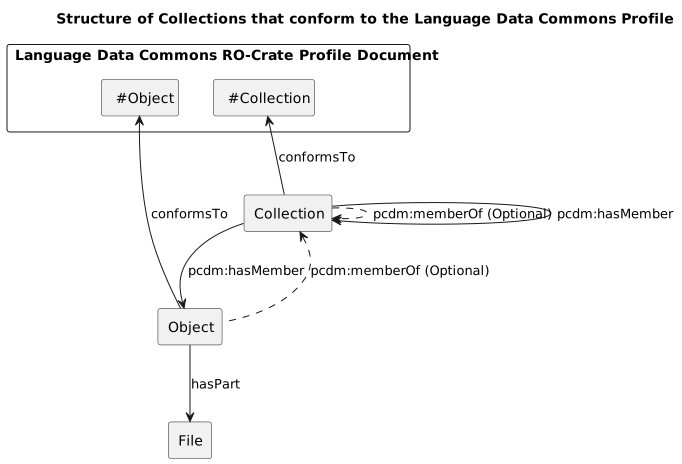
Structure of collections that conform to the Language Data Commons Profile

A collection such as a corpus may be stored in a repository or transmitted either as:

Distributed collections may reference member collections or Objects in pcdm:hasMember property but should not include descriptions of Objects that are stored elsewhere in the repository.


Classes

In linked data, a class is a resource that represents a concept or entity. Classes specific to the Language Data Commons Schema include:

Class Description
CollectionEvent A description of an event at which one or more PrimaryMaterials were captured, e.g. as video or audio.
CollectionProtocol A description of how this Object or Collection was obtained, such as the strategy used for selecting written source texts, or the prompts given to participants.
DataDepositLicense A license document setting out terms for deposit into a repository.
DataLicense A license document for data licensing. This is a superclass of DataReuseLicense and DataDepositLicense.
DataReuseLicense A license document, setting out terms for reuse of data.

Bidirectional Relationships

The relational hierachy between Collections, Objects and Files are represented bidirectionally in an RO-Crate by the terms hasPart/isPartOf and pcdm:hasMember/pcdm:memberOf.

Superset Term Inverse Of Subset Term
pcdm:hasMember pcdm:memberOf
hasPart isPartOf

Objects are placed in a Collection using the pcdm:memberOf property, which is required. The inverse will be encoded automatically using the pcdm:hasMember property on a Collection. Similarly, if using pcdm:hasMember, pcdm:memberOf will also be automatically encoded.

The same relationship applies for hasPart and isPartOf at the Object and File levels.

Superset Level Relationship Subset Level
Collection pcdm:hasMember Object
Collection pcdm:memberOf Object
Object hasPart File
Object isPartOf File

Depending on the data, using one term over another may be preferable when creating the hierarchical relationship. For example, if you are describing multiple files in a spreadsheet, it is easier to use isPartOf at the File level referencing the Object it belongs to, rather than listing all the hasPart entries at the Object level.

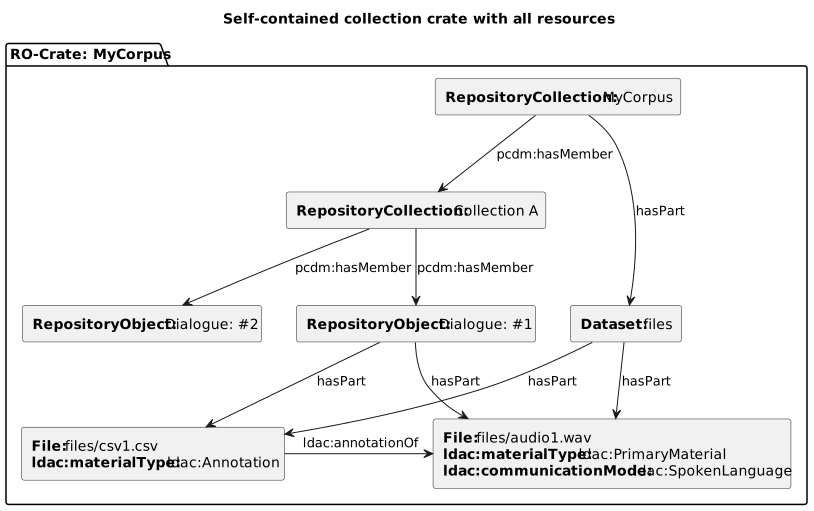
The following diagram shows how these relationships are encoded in a single "bundled" RO-Crate.

Self-contained collection crate with all resources

The next diagram shows how distributed crates (with one RO-Crate per Object and Collection) are linked.

Distributed crate with links to object crates

Which linking strategy is used is an implementation choice for repository developers.


When to choose collection-as-crate ("bundled") vs collection-in-multiple-crates ("distributed")


Collection

A collection is a group of related Objects. Examples of collections include corpora, and sub-corpora, as well as aggregations of cultural objects such as PARADISEC collections which bring together items collected in a region or on a session with informants. This follows the Alveo usage:

Items [Objects in this model] are grouped into collections which might correspond to curated corpora such as ACE or informal collections such as a sample of documents from the AustLit archive.

When an RO-Crate is used to package a collection that is part of another Collection it has a pcdm:memberOf property which references a resolvable ID (within the context of a repository or service) of the parent Collection. The Collection may also list its members in a pcdm:hasMember property, but this is not required.

The root dataset must have at least these @type values: ["Dataset", "RepositoryCollection"]

A RepositoryCollection:


Object

An Object is a single unit linked to tightly related files, for example, a dialogue or session in a speech study, or a work (document) in a written corpus. This is based on the use of the term Item in Alveo:

The data model that we have developed for the storage of language resources is built around the concept of an item which corresponds (loosely) to a record of a single communication event. An item is often associated with a single text, audio or video resource but could include a number of resources, for example, the different channels of audio recording, or an audio recording and associated textual transcript. Items are grouped into collections which might correspond to curated corpora such as ACE or informal collections such as a sample of documents from the AustLit archive. https://www.researchonline.mq.edu.au/vital/access/services/Download/mq:37347/DS01

The definition of an object is necessarily loose and needs to reflect what data owners have chosen to do with their collections in the past.

If an RO-Crate contains a single Object, the Root Dataset would have a @type property of ["Dataset", "RepositoryObject"] with a conformsTo property pointing to the Language Data Commons Object profile https://w3id.org/ldac/profile#Object (this document).

If an RO-Crate contains an entire collection, each Object has a @type property of ["Dataset", "RepositoryObject"] and a conformsTo property referencing this document. For example:

Objects SHOULD have files (which may be included in an RO-Crate for the object, or as part of a collection crate).

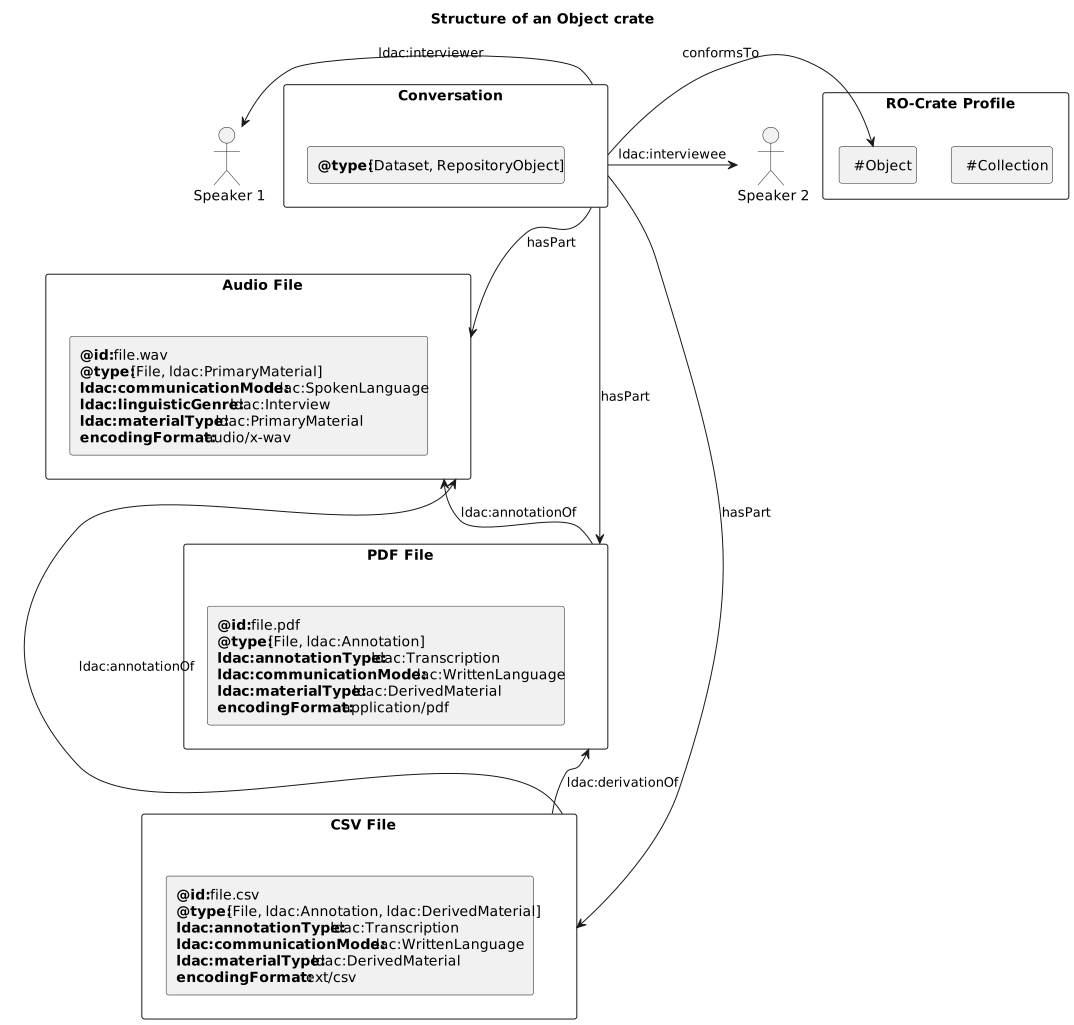
In this example, the Object in question is an interview from a speech corpus with three files. The diagram shows the relationships between the object and its files (and the contextual metadata of a Person who takes the role of the speaker/informant (discussed in more detail below).

Structure of an Object crate

There are a number of terms that can be used to characterise resources - these use the Schema.org mechanism of DefinedTerm and DefinedTermSet.

Defined Term Sets

Defined Term Set: Access Types

ID: ldac:AccessTypes

Set of defined terms for ldac:access

Term Description
Authorized Access Indicates that a DataReuseLicense requires some kind of authorization step, from SelfAuthorization (click-through) to processes that require a data steward to grant permission.
Open Access Data covered by this license may be accessed as long as the license is served alongside it, and does not require any specific authorization step.

Defined Term Set: Annotation Type Terms

ID: ldac:AnnotationTypeTerms

Set of defined terms for ldac:annotationType

Term Description
Gestural The resource describes the gestural content of the resource it annotates.
Orthographic The resource contains annotations using orthography (a writing system) as opposed to a coded representation such as a phonetic transcription.
Part Of Speech An annotation that assigns lexical elements of language to classes on the basis of their distributional properties (for sign languages, the term 'sign class' is appropriate).
Phonemic An annotation that represents speech in terms of the sound contrasts made in a language.
Phonetic A representation of speech in terms of the sounds produced, typically using the International Phonetic Alphabet.
Phonological An annotation that includes information about the sound system of a language, such as the contrasts between sounds which make up the sound system and the locally conditioned realisations of sounds which characterise speech in the language.
Prosodic An annotation that provides a symbolic record of intonation, stress, tone or other suprasegmental features, which is expressed independently of regular phonetic transcription.
Semantic The resource includes annotation or analysis concerning the encoding of meaning.
Syntactic The resource contains annotation or analysis describing the combinatorial patterns of words in another resource.
Transcription The resource contains a transcription, which is a written representation (orthographic or coded) of an audio or visual signal.
Translation This is a translation of a resource in another language.

Defined Term Set: Authorization Workflows

ID: ldac:AuthorizationWorkflows

Set of defined terms for ldac:authorizationWorkflow

Term Description
Access Control List License grants access to data based on a list of approved users, specified using the property accessControlList.
Agree to Terms A user is expected to explicitly agree to a set of license terms, this may be combined with AccessControlList - to note that even if a user has been pre-approved for a license they must agree to license terms.
Authorization By Application Users may apply for a license via some workflow, such as a form, with the decision being made by a DataSteward or their delegate about whether to grant the license.
Authorization By Invitation A data steward or administrator is expected to use an access control system to invite users, for example, participants, collaborators or students.
Self Authorization A user can be authorised to access data by clicking that they agree to a license, or filling out a form to check their understanding, which can be validated by a machine and does not require human intervention.

Defined Term Set: Collection Event Type Terms

ID: ldac:CollectionEventTypeTerms

Set of defined terms for ldac:collectionEventType

Term Description
Session A collection event that is a recording or elicitation session with participants.

Defined Term Set: Collection Protocol Type Terms

ID: ldac:CollectionProtocolTypeTerms

Set of defined terms for ldac:collectionProtocolType

Term Description
Elicitation Task The collection protocol includes a task-based prompt to participants.
Material Selection Criteria A description of the criteria used to select texts in a collection.

Defined Term Set: Communication Mode Terms

ID: ldac:CommunicationModeTerms

Set of defined terms for ldac:communicationMode

Term Description
Gesture The resource contains non-linguistic gestural communication (i.e. not sign language).
Signed Language The resource contains data for which the medium of interaction was signing.
Song The resource contains data for which the medium of interaction was song.
Spoken Language The resource contains data for which the medium of interaction was speech.
Whistled Language The resource contains data for which the medium of interaction was whistling.
Written Language The resource contains data for which the medium of interaction was writing.

Defined Term Set: Index Types

ID: ldac:IndexTypes

Set of defined terms for ldac:openAccessIndex

Term Description
Full Text A text index that makes the full text of a data resource findable via a search interface.

Defined Term Set: Linguistic Genre Terms

ID: ldac:LinguisticGenreTerms

Set of defined terms for ldac:linguisticGenre

Term Description
Dialogue An interactive discourse with two or more participants. Examples of dialogues include conversations, interviews, correspondence, consultations, greetings and leave-takings.
Drama A planned, creative rendition of discourse with two or more participants intended for presentation to an audience.
Formulaic The resource is a ritually or conventionally structured discourse.
Informational Discourse whose primary purpose is to inform the audience about the natural or social world.
Interview The resource is a conversation where one or more speakers are directing the conversation.
Lexicon The resource includes a systematic listing of lexical items.
Ludic Language whose primary function is to be part of play, or a style of speech that involves a creative manipulation of the structures of the language. Examples of ludic discourse are play languages, jokes, secret languages, and speech disguises.
Narrative A discourse, monologic or co-constructed, which represents temporally organised events. Types of narratives include historical, traditional, and personal narratives, myths, folktales, fables, and humorous stories.
Oratory The art of public speaking, or of speaking eloquently according to rules or conventions. Examples of oratory include sermons, lectures, political speeches, and invocations.
Procedural An explanation or description of a method, process, or situation having ordered steps.
Report A factual account of some event or circumstance.
Thesaurus The resource contains a list or data structure consisting of words or concepts arranged according to sense.

Defined Term Set: Material Types

ID: ldac:MaterialTypes

Set of defined terms for ldac:materialType

Term Description
Annotation The resource includes material that adds information to some other linguistic record.
Derived Material This is derived from another source, such as a Primary Material, via some process, e.g. a downsampled video or a sample or an abstract of a resource that is not an annotation (an analysis or description).
Primary Material The object of study, such as a literary work, film, or recording of natural discourse.

Defined Term Set: Written Language Type Terms

ID: ldac:WrittenLanguageTypeTerms

Set of defined terms for ldac:writtenLanguageFormat

Term Description
Handwritten The resource was written using a writing implement such as a pen, pencil, brush or computer stylus (except where the digital handwriting is converted to standard text).
Typeset The resource has been formatted for printing or display.
Typewritten The resource contains text produced on a typewriter.

A RepositoryObject:


Files

There are three important types of files (or references to other works) that may be included: ldac:PrimaryMaterial which is a recording or original text, or a citation of or proxy for it, ldac:DerivedMaterial which has been generated or sampled from primary material by a process such as format conversion or digitization, and ldac:Annotation, which contains one or more types of analysis of the ldac:PrimaryMaterial or ldac:DerivedMaterial.

A File:

Class: File

A media object, such as an image, video, audio, or text object embedded in a web page or a downloadable dataset i.e. DataDownload.

Instances of this type MAY be present in the crate.

Min Count Max Count
N/A N/A
Property Specialization Of Required Description Range Value
@type Yes MediaObject
contentSize http://schema.org/contentSize No File size in (mega/kilo)bytes. Text
ldac:derivationOf https://w3id.org/ldac/terms#derivationOf No This property references another resource from which the current resource is derived, e.g. downsampling audio or video files, or extracting text from a PDF. Annotation, Primary Material
encodingFormat http://schema.org/encodingFormat No The media type typically expressed using a MIME format. Text, WebPage, CreativeWork
ldac:hasDerivation https://w3id.org/ldac/terms#hasDerivation No This property references another resource that is derived from it, such as a downsampled audio or video file, or text extracted from a PDF. Derived Material
hasPart http://schema.org/hasPart No An item or CreativeWork that is part of this item, or CreativeWork (in some sense). Creative Work, File
ldac:materialType https://w3id.org/ldac/terms#materialType No Indicates whether the material in a file is the original (primary) source or is derived from it or describes it via annotation. Material Types

ldac:PrimaryMaterial

ldac:PrimaryMaterial may be a video or audio file if it is available, or may be a ContextualEntity referencing a primary text such as a book.

ldac:DerivedMaterial

ldac:DerivedMaterial is a non-analytical derivation from ldac:PrimaryMaterial, for example, downsampled video or excerpted text.

ldac:Annotation

ldac:Annotation is a description or analysis of other material. More than one type of annotation may be present in a file.

Describing the columns in CSV or other tabular data

CSV or similar tabular files are often used to represent transcribed speech or sign language data, sometimes also with time codes. To enable automated location of which column is which, use a frictionless Table Schema described by a File entity in the crate.

For example: ${exampleEntities('art', ['art_schema.json'])}


Places

The place in which data was collected may be indicated using the contentLocation property.

${exampleEntities('paradisec-item-NT1-001', ['./', 'https://www.ethnologue.com/country/VU', '#Vanuatu'])}


Identifiers

Identifiers for Objects and Collections MUST be URIs.

Internally, identifiers for all entities that do not have their own URIs may use the Archive and Packaging identifier scheme (ARCP), which allows for a DNS-like namespacing of identifiers. For example, the Sydney Speaks corpus top-level collection would have the ID:

arcp://name,http://www.dynamicsoflanguage.edu.au/sydney-speaks/corpus/

A sub-corpus (collection) would have an ID like:

arcp://name,http://www.dynamicsoflanguage.edu.au/sydney-speaks/corpus/collection/SSP

An object:

arcp://name,http://www.dynamicsoflanguage.edu.au/sydney-speaks/corpus/object/331

A person:

arcp://name,http://www.dynamicsoflanguage.edu.au/sydney-speaks/corpus/person/54

How to record people's contributions

Some corpora express ages and other demographics of participants - this presents a data modelling challenge, as age and some other variables change over time, so if the same person appears over time then we need to have a base Person with date of birth etc. as well as time-based instances of the person with an age, social status, gender etc. at that time.

There are three levels at which contributions to an object can be modelled:

  1. Include one or more Person items as context in a crate and reference them with properties such as creator or the Language Data Commons Vocabulary properties such as ldac:compiler or ldac:depositor. The @id of the person MUST be a URI and SHOULD be re-used where the same person appears in multiple objects in a collection or repository.

  2. For longitudinal studies where it is important to record changing demographic information for a Person, or where precision is required in listing contributions to a work use ldac:PersonSnapshot.

  3. If it is important to record lots of contributions to a work (e.g. in analysis of a joint work) use Action. If more precision is required in describing the provenance of items, e.g. this work on The Declaration of Rights of Man and of the Citizen (Lorber-Kasunic & Sweetapple).

    NOTE: If this approach is used, special care will have to be taken in developing user interfaces and/or training communities to use this way of modelling metadata; the user need not see the underlying structure. This profile does not give advice about how to do this as we have not seen a use case that requires it.


Collection events such as "Sessions"

Where data is collected from participants in a speech study with elicitation tasks such as "sessions" (see this IMDI document) or field interviews, this can be recorded in metadata via the CollectionEvent class.

The indirection in this conforms-to relationship is to allow multiple objects to have a conformsTo property which indicates that they conform to the same schema while having a local copy of the schema, as per RO-Crate best practice of having all local context to use a data packages in the package where possible.


References

Himmelmann, Nikolaus P. 2012. Linguistic data types and the interface between language documentation and description. Language documentation & conservation. University of Hawai'i Press 6. 187--207.

Paterson, Hugh Joseph. 2021. Language Archive Records: Interoperability of Referencing Practices and Metadata Models. United States -- North Dakota: The University of North Dakota M.A. https://www.proquest.com/docview/2550236802/abstract/22686A0E508D4E5CPQ/1 (3 May 2022).


Examples

https://www.mpi.nl/ISLE/documents/docs_frame.html

30 classes · 101 properties

Classes

  • Collection — An aggregation of resources. #class_dct:Collection
  • Collection Event — A description of an event at which one or more PrimaryMaterials were captured, e.g. as video or audio. #class_CollectionEvent
  • Collection Protocol — A description of how this Object or Collection was obtained, such as the strategy used for selecting written source texts, or the prompts given to participants. #class_ldac:CollectionProtocol
  • Creative Work — The most generic kind of creative work, including books, movies, photographs, software programs, etc. #class_CreativeWork
  • Data Deposit License — A license document setting out terms for deposit into a repository. #class_DataDepositLicense
  • Data License — A license document for data licensing. This is a superclass of DataReuseLicense and DataDepositLicense. #class_DataLicense
  • Data Reuse License — A license document, setting out terms for reuse of data. #class_DataReuseLicense
  • Dataset — A body of structured information describing some topic(s) of interest. #class_Dataset
  • Dataset — Data encoded in a defined structure. #class_dct:Dataset
  • Event — A non-persistent, time-based occurrence. #class_dct:Event
  • File — A media object, such as an image, video, audio, or text object embedded in a web page or a downloadable dataset i.e. DataDownload. #class_File
  • Geometry — A coherent set of direct positions in space. The positions are held within a Spatial Reference System (SRS). #class_Geometry
  • Image — A visual representation other than text. #class_dct:Image
  • Interactive Resource — A resource requiring interaction from the user to be understood, executed, or experienced. #class_dct:InteractiveResource
  • Language — Natural languages such as Spanish, Tamil, Hindi, English, etc. #class_Language
  • Moving Image — A series of visual representations imparting an impression of motion when shown in succession. #class_dct:MovingImage
  • Organization — An organization such as a school, NGO, corporation, club, etc. #class_Organization
  • Person — A person (alive, dead, undead, or fictional). #class_Person
  • Physical Object — An inanimate, three-dimensional object or substance. #class_dct:PhysicalObject
  • Place — Entities that have a somewhat fixed, physical extension. #class_Place
  • README Entity — An Data Package MUST contain a README file that describes the contents of the package. This entity represents the README.html file. #README_Entity
  • Repository Collection — A Collection is a group of resources. Collections have descriptive metadata, access metadata, and may links to works and/or collections. By default, member works and collections are an unordered set, but can be ordered using the ORE Proxy class. #class_RepositoryCollection
  • Repository Object — An Object is an intellectual entity, sometimes called a "work", "digital object", etc. Objects have descriptive metadata, access metadata, may contain files and other Objects as member "components". Each level of a work is therefore represented by an Object instance, and is capable of standing on its own, being linked to from Collections and other Objects. Member Objects can be ordered using the ORE Proxy class. #class_RepositoryObject
  • RO-Crate Metadata Descriptor — An RO-Crate @graph must contain an entity of Type @CreativeWork which is known as the RO-Crate Metadata descriptor. #RO-Crate_Metadata_Descriptor
  • Root Data Entity — The Root Data Entity for an RO-Crate. This is the main entity of the RO-Crate and is the one that is referenced by the RO-Crate Metadata Descriptor. In this profile, it is a Dataset and RepositoryCollection. #Root_Data_Entity
  • Service — A system that provides one or more functions. #class_dct:Service
  • Software — A computer program in source or compiled form. #class_dct:Software
  • Sound — A resource primarily intended to be heard. #class_dct:Sound
  • Still Image — A static visual representation. #class_dct:StillImage
  • Text — A resource consisting primarily of words for reading. #class_dct:Text

Properties

  • @id — README file #README.id
  • About — This property on the RO-Crate Metadata Descriptor references the Root Data Entity. In a SoSS+ profile there may be Schemas present for more than one 'flavour' of Root Data Entity with different @type arrays or `@conformsTo` references (or other specializations). #RO-Crate_Metadata_Descriptor.about
  • Access — Whether this is an open or restricted access license. #prop_ldac:access_DataReuseLicense
  • Access Control List — When a license has an authorizationWorkflow property with a value of the DefinedTerm AccessControlList this property has a URI value that points to a list of userIDs. #prop_ldac:accessControlList_DataReuseLicense
  • Accountable Person — The person or organisation who is the data steward for this resource. #prop_accountablePerson_Dataset
  • Address — The physical address of the place. #prop_address_Place
  • Affiliation — The organisation that this person is affiliated with. For example, a university or school. #prop_affiliation_Person
  • Age — The age or age range of a person, e.g. 25, 30-50, >50. If an age is specified, a specializationOf pointing to a 'canonical' ageless version of that Person can also be included. #prop_ldac:age_Person
  • Annotation Of — This resource contains some kind of description that adds information to the resource it references. #prop_ldac:annotationOf_Dataset
  • Annotation Type — The type of an Annotation resource. #prop_ldac:annotationType_CreativeWork
  • Annotator — The participant produced an annotation of this or a related resource. #prop_ldac:annotator_Dataset
  • As WKT — The WKT serialisation of the geometry. #prop_geosparql:asWKT_Geometry
  • Author — The person or organisation responsible for creating this work. Authors should be identified using URIs such as ORCiD or ROR. #prop_author_CreativeWork
  • Author — The person or organisation responsible for creating this collection of data. Authors should be identified using URIs such as ORCiD or ROR. #prop_author_Dataset
  • Authorization Workflow — By what process a user is granted authorization to a license. #prop_ldac:authorizationWorkflow_DataReuseLicense
  • Channels — The number of audio channels this resource contains (e.g. 1, 2, 5.1). #prop_ldac:channels_CreativeWork
  • Citation — Associated publications. #prop_citation_Dataset
  • Collection Event Type — A kind of CollectionEvent characterised by some specific procedures, e.g. a psycholinguistic experiment. #prop_ldac:collectionEventType_CollectionEvent
  • Collection Protocol Type — A description of the process used to collect or collate data, such as prompts given to participants, or how texts are selected for inclusion in a collection. #prop_ldac:collectionProtocolType_ldac:CollectionProtocol
  • Communication Mode — The mode (spoken, written, signed etc.) of this resource. There may be more than one value for this property. #prop_ldac:communicationMode_CreativeWork
  • Compiler — The participant is responsible for collecting the sub-parts of the resource together. #prop_ldac:compiler_Dataset
  • Conforms To — A link to the language data commons RO-Crate profile for collections. #prop_conformsTo_RepositoryCollection
  • Conforms To — A link to the language data commons RO-Crate profile for collections. #prop_conformsTo_RepositoryObject
  • Consultant — The participant contributes expertise to the creation of a work, for example by contributing knowledge of their native language. #prop_ldac:consultant_Dataset
  • Content Location — The location depicted or described in the content. For example, the location in a photograph or painting. #prop_contentLocation_RepositoryCollection
  • Content Size — File size in (mega/kilo)bytes. #prop_contentSize_File
  • Creator — The creator/author of this CreativeWork. This is the same as the Author property for CreativeWork. #prop_creator_RepositoryObject
  • Credit Text — A free text bibliographic citation for this material, e.g. 'Cite as: Musgrave (2023). Title of work. DOI'. #prop_creditText_Dataset
  • Data Inputter — The participant responsible for entering, re-typing, and/or structuring the data contained in the resource. #prop_ldac:dataInputter_Dataset
  • Date Created — The (earliest) date the data in this dataset were created. #prop_dateCreated_RepositoryCollection
  • Date Created — The date on which the CreativeWork was created or the item was added to a DataFeed. #prop_dateCreated_RepositoryObject
  • Date Free Text — Date information which cannot be put in one of the standard date formats, e.g. 'mid-1970s', or it is not clear, for example, if it is a creation or publication date. #prop_ldac:dateFreeText_RepositoryCollection
  • Date Published — A date that this collection was published. This should be the date that the collection was first made available. #prop_datePublished_Dataset
  • Depositor — The participant responsible for depositing the resource in an archive. #prop_ldac:depositor_Dataset
  • Derivation Of — This property references another resource from which the current resource is derived, e.g. downsampling audio or video files, or extracting text from a PDF. #prop_ldac:derivationOf_File
  • Description — An abstract of the collection. Include as much detail as possible about the motivation and use of the collection. #prop_description_Dataset
  • Description — A description of the item. #prop_description_RepositoryObject
  • Developer — The participant developed the methodology or tools (including software) that constitute the resource, or that were used to create the resource. #prop_ldac:developer_Dataset
  • DOI — A Digital Object Identifier, e.g. https://doi.org/10.1000/182. #prop_ldac:doi_Dataset
  • Editor — The participant reviewed, corrected, and/or tested the resource. #prop_ldac:editor_Dataset
  • Encoding Format — The media type typically expressed using a MIME format. #prop_encodingFormat_File
  • Funder — The organisation(s) responsible for funding the creation or collection of this dataset. #prop_funder_Dataset
  • Geo — The geographic coordinates of the place. #prop_geo_Place
  • Has Annotation — This resource is referenced by another resource that adds information to it such as a translation, transcription or other analysis. #prop_ldac:hasAnnotation_RepositoryObject
  • Has Collection Protocol — A link to a CollectionProtocol object with (at least) a summary of how resources were selected or elicited for this collection/sub-collection. #prop_ldac:hasCollectionProtocol_Dataset
  • Has Derivation — This property references another resource that is derived from it, such as a downsampled audio or video file, or text extracted from a PDF. #prop_ldac:hasDerivation_File
  • Has Member — The sub-collections, if any, associated with this collection. #prop_pcdm:hasMember_Dataset
  • Has Part — An item or CreativeWork that is part of this item, or CreativeWork (in some sense). #prop_hasPart_Dataset
  • Has Part — An item or CreativeWork that is part of this item, or CreativeWork (in some sense). #prop_hasPart_File
  • Holding Archive — Organisation where the original of this work or collection is housed. #prop_holdingArchive_RepositoryCollection
  • ID — The RO-Crate Metadata Descriptor #RO-Crate_Metadata_Descriptor.id
  • Identifier — The identifier property represents any kind of identifier for any kind of [[Thing]], such as ISBNs, GTIN codes, UUIDs etc. Schema.org provides dedicated properties for representing many of these, either as textual strings or as URL (URI) links. See [background notes](/docs/datamodel.html#identifierBg) for more details. #prop_identifier_RepositoryObject
  • Illustrator — The participant contributed drawings or other illustrations to the resource. #prop_ldac:illustrator_Dataset
  • In Language — The language in which the resource is written. #prop_inLanguage_RepositoryCollection
  • Indexable Text — One or more target File(s) that together contain the full text of an item – each file should indicate its language. #prop_ldac:indexableText_CreativeWork
  • Interpreter — The contributor renders the discourse recorded in the resource into another language in real time, or the contributor explains the discourse recorded in the resource. #prop_ldac:interpreter_Dataset
  • Interviewee — The participant was a respondent in an interview. #prop_ldac:interviewee_Dataset
  • Interviewer — The participant conducted an interview that forms part of the resource. #prop_ldac:interviewer_Dataset
  • Is Accessible For Free — This is available under an Open Access license. #prop_isAccessibleForFree_Dataset
  • Is Based On — Link to or description of an original resource. #prop_isBasedOn_Dataset
  • Is De-Identified — The data in this item has had potentially identifying information removed, which may include replacing names with pseudonyms. #prop_ldac:isDeIdentified_CreativeWork
  • Is Part Of — An item or CreativeWork that this item, or CreativeWork (in some sense), is part of. #prop_isPartOf_Dataset
  • ISBN — The ISBN for this work, if applicable. #prop_isbn_CreativeWork
  • ISSN — The ISSN for this publication. #prop_issn_CreativeWork
  • Item Location — Current location of the item, e.g. where a set of audio tapes are stored. #prop_ldac:itemLocation_RepositoryCollection
  • License — A license document that applies to this content, typically indicated by URL. #prop_license_Dataset
  • License — A license document that applies to this content, typically indicated by URL. #prop_license_RepositoryObject
  • Linguistic Genre — A linguistic classification of the genre of this resource. #prop_ldac:linguisticGenre_CreativeWork
  • Location — A location for the organisation, e.g. a city for a publisher. #prop_location_Organization
  • Main Text — Identifies the most relevant sub-component for computational text analytics. #prop_ldac:mainText_CreativeWork
  • Material — Description of the original media, e.g. audio cassette tapes, participant questionnaires, field notes. #prop_ldac:material_CreativeWork
  • Material Type — Indicates whether the material in a file is the original (primary) source or is derived from it or describes it via annotation. #prop_ldac:materialType_File
  • Member Of — Links from a Repository Object or Collection to a containing Repository Object or Collection. #prop_pcdm:memberOf_Dataset
  • Name — The name of this data collection. #prop_name_Dataset
  • Open Access Index — One or more public index types allowed by a license, e.g. FullText indexing may be allowed for discovery even when an item is not. #prop_ldac:openAccessIndex_CreativeWork
  • Orthographic Notes — A description of the specific orthographic writing system(s) used in the material (e.g. Latin, Cyrillic, Australian English, IPA), or particular conventions required to understand the material (e.g. O* = ø). #prop_ldac:orthographicNotes_CreativeWork
  • Participant — The participant was present during the creation of the resource, but did not contribute substantially to its content. #prop_ldac:participant_Dataset
  • Performer — The participant performed some portion of a recorded, filmed, or transcribed resource. It is recommended that this term be used only for creative participants whose role is not better indicated by a more specific term, such as 'speaker', 'signer', or 'singer'. #prop_ldac:performer_Dataset
  • Photographer — The participant took the photograph, or shot the film, that appears in or constitutes the resource. #prop_ldac:photographer_Dataset
  • Publisher — The organisation that published this work. #prop_publisher_CreativeWork
  • Publisher — The organisation responsible for releasing this dataset. #prop_publisher_Dataset
  • Recipient — The person or organisation responsible for creating this work. Authors should be identified using URIs such as ORCiD or ROR. #prop_recipient_CreativeWork
  • Recorder — The participant operated the recording machinery used to create the resource. #prop_ldac:recorder_Dataset
  • Register — The type of register (any of the varieties of a language that a speaker uses in a particular social context [Merriam-Webster]) of the contents of a language resource. #prop_ldac:register_CreativeWork
  • Research Participant — The participant acted as a research subject or responded to a questionnaire, the results of which study form the basis of the resource. #prop_ldac:researchParticipant_Dataset
  • Researcher — The resource was created as part of the participant's research, or the research presents interim or final results from the participant's research. #prop_ldac:researcher_Dataset
  • Responder — The participant was an interlocutor in some sort of discourse event, but only reacted to the contributions of others. #prop_ldac:responder_Dataset
  • Review Date — The date that this license should be reviewed. #prop_ldac:reviewDate_DataLicense
  • Rights Holder — The person or organisation owning or managing rights over the resource. #prop_dct:rightsHolder_Dataset
  • Signer — The contributor was a principal signer in a resource that consists of a recording, a film, or a transcription of a recorded resource. Signers are those whose gestures predominate in a recorded or filmed resource. (The resource may be a transcription of that recording). #prop_ldac:signer_Dataset
  • Singer — The participant sang, either individually or as part of a group, in a resource that consists of a recording, a film, or a transcription of a recorded resource. #prop_ldac:singer_Dataset
  • Spatial Coverage — The place(s) that are the focus of the content. It is a sub-property of contentLocation intended primarily for more technical and detailed materials. For example, with a dataset, it indicates areas that the dataset describes: a dataset Cape York languages would have spatialCoverage which was the place: the outline of the Cape. #prop_spatialCoverage_Dataset
  • Speaker — The contributor was a principal speaker in a resource that consists of a recording, a film, or a transcription of a recorded resource. Speakers are those whose voices predominate in a recorded or filmed resource. (The resource may be a transcription of that recording). #prop_ldac:speaker_Dataset
  • Sponsor — The participant contributed financial support to the creation of the resource. #prop_ldac:sponsor_Dataset
  • Subject Language — The languages that the materials in the collection are about (not the language that it is in). #prop_ldac:subjectLanguage_RepositoryCollection
  • Temporal Coverage — The range of years of creation for items in this dataset using a slash, e.g. 1900/1945. If there are sub-collections with different coverages put this on the sub-collections not the top-level. #prop_temporalCoverage_Dataset
  • Temporal Coverage — The temporalCoverage of a CreativeWork indicates the period that the content applies to, i.e. that it describes, either as a DateTime or as a textual string indicating a time period in [ISO 8601 time interval format](https://en.wikipedia.org/wiki/ISO_8601#Time_intervals). In the case of a Dataset it will typically indicate the relevant time period in a precise notation (e.g. for a 2011 census dataset, the year 2011 would be written "2011/2012"). Other forms of content, e.g. ScholarlyArticle, Book, TVSeries or TVEpisode, may indicate their temporalCoverage in broader terms - textually or via well-known URL. Written works such as books may sometimes have precise temporal coverage too, e.g. a work set in 1939 - 1945 can be indicated in ISO 8601 interval format format via "1939/1945". Open-ended date ranges can be written with ".." in place of the end date. For example, "2015-11/.." indicates a range beginning in November 2015 and with no specified final date. This is tentative and might be updated in future when ISO 8601 is officially updated. #prop_temporalCoverage_RepositoryObject
  • Transcriber — The participant produced a transcription of this or a related resource. #prop_ldac:transcriber_Dataset
  • Translator — The participant produced a translation of this or a related resource. #prop_ldac:translator_Dataset
  • Usage Info — Additional information on licensing options for using the data, e.g. 'Contact the Data Steward to discuss license terms'. #prop_usageInfo_Dataset
  • Written Language Format — The format of the resource resulting from the way the text was produced (handwritten, typeset, typewritten). #prop_ldac:writtenLanguageFormat_CreativeWork

Types of entities (specializations of Classes) and expected Properties

Class: Collection Event

A description of an event at which one or more PrimaryMaterials were captured, e.g. as video or audio.

Instances of this type MAY be present in the crate.

Min Count Max Count
N/A N/A
Property Specialization Of Required Description Range Value
@type Yes CollectionEvent
ldac:collectionEventType https://w3id.org/ldac/terms#collectionEventType No A kind of CollectionEvent characterised by some specific procedures, e.g. a psycholinguistic experiment. Collection Event Type Terms

Class: Creative Work

The most generic kind of creative work, including books, movies, photographs, software programs, etc.

Instances of this type MAY be present in the crate.

Min Count Max Count
N/A N/A
Property Specialization Of Required Description Range Value
@type Yes CreativeWork
ldac:annotationType https://w3id.org/ldac/terms#annotationType No The type of an Annotation resource. Annotation Type Terms
author http://schema.org/author No The person or organisation responsible for creating this work. Authors should be identified using URIs such as ORCiD or ROR. Text, Person, Organization
ldac:channels https://w3id.org/ldac/terms#channels No The number of audio channels this resource contains (e.g. 1, 2, 5.1). Text
ldac:communicationMode https://w3id.org/ldac/terms#communicationMode No The mode (spoken, written, signed etc.) of this resource. There may be more than one value for this property. Communication Mode Terms
ldac:indexableText https://w3id.org/ldac/terms#indexableText No One or more target File(s) that together contain the full text of an item – each file should indicate its language. MediaObject
ldac:isDeIdentified https://w3id.org/ldac/terms#isDeIdentified No The data in this item has had potentially identifying information removed, which may include replacing names with pseudonyms. Boolean
isbn http://schema.org/isbn No The ISBN for this work, if applicable. Text
issn http://schema.org/issn No The ISSN for this publication. Text
ldac:linguisticGenre https://w3id.org/ldac/terms#linguisticGenre No A linguistic classification of the genre of this resource. Linguistic Genre Terms
ldac:material https://w3id.org/ldac/terms#material No Description of the original media, e.g. audio cassette tapes, participant questionnaires, field notes. Text
ldac:openAccessIndex https://w3id.org/ldac/terms#openAccessIndex No One or more public index types allowed by a license, e.g. FullText indexing may be allowed for discovery even when an item is not. Index Types
publisher http://schema.org/publisher No The organisation that published this work. Text, Organization
recipient http://schema.org/recipient No The person or organisation responsible for creating this work. Authors should be identified using URIs such as ORCiD or ROR. Text, Person, Organization
ldac:register https://w3id.org/ldac/terms#register No The type of register (any of the varieties of a language that a speaker uses in a particular social context [Merriam-Webster]) of the contents of a language resource. Text
ldac:writtenLanguageFormat https://w3id.org/ldac/terms#writtenLanguageFormat No The format of the resource resulting from the way the text was produced (handwritten, typeset, typewritten). Written Language Type Terms

Class: Data Deposit License

A license document setting out terms for deposit into a repository.

Instances of this type MAY be present in the crate.

Min Count Max Count
N/A N/A
Property Specialization Of Required Description Range Value
@type Yes DataDepositLicense
No properties defined for this class

Class: Data License

A license document for data licensing. This is a superclass of DataReuseLicense and DataDepositLicense.

Instances of this type MAY be present in the crate.

Min Count Max Count
N/A N/A
Property Specialization Of Required Description Range Value
@type Yes DataLicense
ldac:reviewDate https://w3id.org/ldac/terms#reviewDate No The date that this license should be reviewed. Text

Class: Data Reuse License

A license document, setting out terms for reuse of data.

Instances of this type MAY be present in the crate.

Min Count Max Count
N/A N/A
Property Specialization Of Required Description Range Value
@type Yes DataReuseLicense
ldac:access https://w3id.org/ldac/terms#access No Whether this is an open or restricted access license. Access Types
ldac:accessControlList https://w3id.org/ldac/terms#accessControlList No When a license has an authorizationWorkflow property with a value of the DefinedTerm AccessControlList this property has a URI value that points to a list of userIDs. URL
ldac:authorizationWorkflow https://w3id.org/ldac/terms#authorizationWorkflow No By what process a user is granted authorization to a license. Authorization Workflows

Class: Dataset

A body of structured information describing some topic(s) of interest.

Instances of this type MAY be present in the crate.

Min Count Max Count
N/A N/A
Property Specialization Of Required Description Range Value
@type Yes Dataset
accountablePerson http://schema.org/accountablePerson Yes The person or organisation who is the data steward for this resource. Person, Organization
author http://schema.org/author Yes The person or organisation responsible for creating this collection of data. Authors should be identified using URIs such as ORCiD or ROR. Person, Organization
publisher http://schema.org/publisher Yes The organisation responsible for releasing this dataset. Organization
dct:rightsHolder http://purl.org/dc/terms/rightsHolder Yes The person or organisation owning or managing rights over the resource. Text, Person, Organization
ldac:annotationOf https://w3id.org/ldac/terms#annotationOf No This resource contains some kind of description that adds information to the resource it references. Primary Material
ldac:annotator https://w3id.org/ldac/terms#annotator No The participant produced an annotation of this or a related resource. Person, Organization
citation http://schema.org/citation No Associated publications. Creative Work
ldac:compiler https://w3id.org/ldac/terms#compiler No The participant is responsible for collecting the sub-parts of the resource together. Person, Organization
ldac:consultant https://w3id.org/ldac/terms#consultant No The participant contributes expertise to the creation of a work, for example by contributing knowledge of their native language. Person, Organization
creditText http://schema.org/creditText No A free text bibliographic citation for this material, e.g. 'Cite as: Musgrave (2023). Title of work. DOI'. Text
ldac:dataInputter https://w3id.org/ldac/terms#dataInputter No The participant responsible for entering, re-typing, and/or structuring the data contained in the resource. Person, Organization
ldac:depositor https://w3id.org/ldac/terms#depositor No The participant responsible for depositing the resource in an archive. Person, Organization
ldac:developer https://w3id.org/ldac/terms#developer No The participant developed the methodology or tools (including software) that constitute the resource, or that were used to create the resource. Person, Organization
ldac:doi https://w3id.org/ldac/terms#doi No A Digital Object Identifier, e.g. https://doi.org/10.1000/182. Text
ldac:editor https://w3id.org/ldac/terms#editor No The participant reviewed, corrected, and/or tested the resource. Person, Organization
funder http://schema.org/funder No The organisation(s) responsible for funding the creation or collection of this dataset. Organization
ldac:hasCollectionProtocol https://w3id.org/ldac/terms#hasCollectionProtocol No A link to a CollectionProtocol object with (at least) a summary of how resources were selected or elicited for this collection/sub-collection. Collection Protocol
pcdm:hasMember http://pcdm.org/models#hasMember No The sub-collections, if any, associated with this collection. Repository Collection, Repository Object
hasPart http://schema.org/hasPart No An item or CreativeWork that is part of this item, or CreativeWork (in some sense). Creative Work, File, Dataset
ldac:illustrator https://w3id.org/ldac/terms#illustrator No The participant contributed drawings or other illustrations to the resource. Person, Organization
ldac:interpreter https://w3id.org/ldac/terms#interpreter No The contributor renders the discourse recorded in the resource into another language in real time, or the contributor explains the discourse recorded in the resource. Person, Organization
ldac:interviewee https://w3id.org/ldac/terms#interviewee No The participant was a respondent in an interview. Person, Organization
ldac:interviewer https://w3id.org/ldac/terms#interviewer No The participant conducted an interview that forms part of the resource. Person, Organization
isAccessibleForFree http://schema.org/isAccessibleForFree No This is available under an Open Access license. Boolean
isBasedOn http://schema.org/isBasedOn No Link to or description of an original resource. Text, URL, Creative Work, Dataset, File
isPartOf http://schema.org/isPartOf No An item or CreativeWork that this item, or CreativeWork (in some sense), is part of. URL, Creative Work
pcdm:memberOf http://pcdm.org/models#memberOf No Links from a Repository Object or Collection to a containing Repository Object or Collection. Repository Collection
ldac:participant https://w3id.org/ldac/terms#participant No The participant was present during the creation of the resource, but did not contribute substantially to its content. Person, Organization
ldac:performer https://w3id.org/ldac/terms#performer No The participant performed some portion of a recorded, filmed, or transcribed resource. It is recommended that this term be used only for creative participants whose role is not better indicated by a more specific term, such as 'speaker', 'signer', or 'singer'. Person, Organization
ldac:photographer https://w3id.org/ldac/terms#photographer No The participant took the photograph, or shot the film, that appears in or constitutes the resource. Person, Organization
ldac:recorder https://w3id.org/ldac/terms#recorder No The participant operated the recording machinery used to create the resource. Person, Organization
ldac:researchParticipant https://w3id.org/ldac/terms#researchParticipant No The participant acted as a research subject or responded to a questionnaire, the results of which study form the basis of the resource. Person, Organization
ldac:researcher https://w3id.org/ldac/terms#researcher No The resource was created as part of the participant's research, or the research presents interim or final results from the participant's research. Person, Organization
ldac:responder https://w3id.org/ldac/terms#responder No The participant was an interlocutor in some sort of discourse event, but only reacted to the contributions of others. Person, Organization
ldac:signer https://w3id.org/ldac/terms#signer No The contributor was a principal signer in a resource that consists of a recording, a film, or a transcription of a recorded resource. Signers are those whose gestures predominate in a recorded or filmed resource. (The resource may be a transcription of that recording). Person, Organization
ldac:singer https://w3id.org/ldac/terms#singer No The participant sang, either individually or as part of a group, in a resource that consists of a recording, a film, or a transcription of a recorded resource. Person, Organization
spatialCoverage http://schema.org/spatialCoverage No The place(s) that are the focus of the content. It is a sub-property of contentLocation intended primarily for more technical and detailed materials. For example, with a dataset, it indicates areas that the dataset describes: a dataset Cape York languages would have spatialCoverage which was the place: the outline of the Cape. Place
ldac:speaker https://w3id.org/ldac/terms#speaker No The contributor was a principal speaker in a resource that consists of a recording, a film, or a transcription of a recorded resource. Speakers are those whose voices predominate in a recorded or filmed resource. (The resource may be a transcription of that recording). Person, Organization
ldac:sponsor https://w3id.org/ldac/terms#sponsor No The participant contributed financial support to the creation of the resource. Person, Organization
temporalCoverage http://schema.org/temporalCoverage No The range of years of creation for items in this dataset using a slash, e.g. 1900/1945. If there are sub-collections with different coverages put this on the sub-collections not the top-level. DateTime, Text
ldac:transcriber https://w3id.org/ldac/terms#transcriber No The participant produced a transcription of this or a related resource. Person, Organization
ldac:translator https://w3id.org/ldac/terms#translator No The participant produced a translation of this or a related resource. Person, Organization
usageInfo http://schema.org/usageInfo No Additional information on licensing options for using the data, e.g. 'Contact the Data Steward to discuss license terms'. Text

Class: Collection

An aggregation of resources.

Instances of this type MAY be present in the crate.

Min Count Max Count
N/A N/A
Property Specialization Of Required Description Range Value
@type Yes Collection
No properties defined for this class

Class: Dataset

Data encoded in a defined structure.

Instances of this type MAY be present in the crate.

Min Count Max Count
N/A N/A
Property Specialization Of Required Description Range Value
@type Yes Dataset
No properties defined for this class

Class: Event

A non-persistent, time-based occurrence.

Instances of this type MAY be present in the crate.

Min Count Max Count
N/A N/A
Property Specialization Of Required Description Range Value
@type Yes Event
No properties defined for this class

Class: Image

A visual representation other than text.

Instances of this type MAY be present in the crate.

Min Count Max Count
N/A N/A
Property Specialization Of Required Description Range Value
@type Yes Image
No properties defined for this class

Class: Interactive Resource

A resource requiring interaction from the user to be understood, executed, or experienced.

Instances of this type MAY be present in the crate.

Min Count Max Count
N/A N/A
Property Specialization Of Required Description Range Value
@type Yes InteractiveResource
No properties defined for this class

Class: Moving Image

A series of visual representations imparting an impression of motion when shown in succession.

Instances of this type MAY be present in the crate.

Min Count Max Count
N/A N/A
Property Specialization Of Required Description Range Value
@type Yes MovingImage
No properties defined for this class

Class: Physical Object

An inanimate, three-dimensional object or substance.

Instances of this type MAY be present in the crate.

Min Count Max Count
N/A N/A
Property Specialization Of Required Description Range Value
@type Yes PhysicalObject
No properties defined for this class

Class: Service

A system that provides one or more functions.

Instances of this type MAY be present in the crate.

Min Count Max Count
N/A N/A
Property Specialization Of Required Description Range Value
@type Yes Service
No properties defined for this class

Class: Software

A computer program in source or compiled form.

Instances of this type MAY be present in the crate.

Min Count Max Count
N/A N/A
Property Specialization Of Required Description Range Value
@type Yes Software
No properties defined for this class

Class: Sound

A resource primarily intended to be heard.

Instances of this type MAY be present in the crate.

Min Count Max Count
N/A N/A
Property Specialization Of Required Description Range Value
@type Yes Sound
No properties defined for this class

Class: Still Image

A static visual representation.

Instances of this type MAY be present in the crate.

Min Count Max Count
N/A N/A
Property Specialization Of Required Description Range Value
@type Yes StillImage
No properties defined for this class

Class: Text

A resource consisting primarily of words for reading.

Instances of this type MAY be present in the crate.

Min Count Max Count
N/A N/A
Property Specialization Of Required Description Range Value
@type Yes Text
No properties defined for this class

Class: File

A media object, such as an image, video, audio, or text object embedded in a web page or a downloadable dataset i.e. DataDownload.

Instances of this type MAY be present in the crate.

Min Count Max Count
N/A N/A
Property Specialization Of Required Description Range Value
@type Yes MediaObject
contentSize http://schema.org/contentSize No File size in (mega/kilo)bytes. Text
ldac:derivationOf https://w3id.org/ldac/terms#derivationOf No This property references another resource from which the current resource is derived, e.g. downsampling audio or video files, or extracting text from a PDF. Annotation, Primary Material
encodingFormat http://schema.org/encodingFormat No The media type typically expressed using a MIME format. Text, WebPage, CreativeWork
ldac:hasDerivation https://w3id.org/ldac/terms#hasDerivation No This property references another resource that is derived from it, such as a downsampled audio or video file, or text extracted from a PDF. Derived Material
hasPart http://schema.org/hasPart No An item or CreativeWork that is part of this item, or CreativeWork (in some sense). Creative Work, File
ldac:materialType https://w3id.org/ldac/terms#materialType No Indicates whether the material in a file is the original (primary) source or is derived from it or describes it via annotation. Material Types

Class: Geometry

A coherent set of direct positions in space. The positions are held within a Spatial Reference System (SRS).

Instances of this type MAY be present in the crate.

Min Count Max Count
N/A N/A
Property Specialization Of Required Description Range Value
@type Yes Geometry
geosparql:asWKT http://www.opengis.net/ont/geosparql#asWKT No The WKT serialisation of the geometry. Text

Class: Language

Natural languages such as Spanish, Tamil, Hindi, English, etc.

Instances of this type MAY be present in the crate.

Min Count Max Count
N/A N/A
Property Specialization Of Required Description Range Value
@type Yes Language
No properties defined for this class

Class: Collection Protocol

A description of how this Object or Collection was obtained, such as the strategy used for selecting written source texts, or the prompts given to participants.

Instances of this type MAY be present in the crate.

Min Count Max Count
N/A N/A
Property Specialization Of Required Description Range Value
@type Yes CollectionProtocol
ldac:collectionProtocolType https://w3id.org/ldac/terms#collectionProtocolType No A description of the process used to collect or collate data, such as prompts given to participants, or how texts are selected for inclusion in a collection. Collection Protocol Type Terms

Class: Organization

An organization such as a school, NGO, corporation, club, etc.

Instances of this type MAY be present in the crate.

Min Count Max Count
N/A N/A
Property Specialization Of Required Description Range Value
@type Yes Organization
location http://schema.org/location No A location for the organisation, e.g. a city for a publisher. Text

Class: Person

A person (alive, dead, undead, or fictional).

Instances of this type MAY be present in the crate.

Min Count Max Count
N/A N/A
Property Specialization Of Required Description Range Value
@type Yes Person
affiliation http://schema.org/affiliation No The organisation that this person is affiliated with. For example, a university or school. Organization
ldac:age https://w3id.org/ldac/terms#age No The age or age range of a person, e.g. 25, 30-50, >50. If an age is specified, a specializationOf pointing to a 'canonical' ageless version of that Person can also be included. Text

Class: Place

Entities that have a somewhat fixed, physical extension.

Instances of this type MAY be present in the crate.

Min Count Max Count
N/A N/A
Property Specialization Of Required Description Range Value
@type Yes Place
address http://schema.org/address No The physical address of the place. Text
geo http://schema.org/geo No The geographic coordinates of the place. Geometry

Class: Repository Collection

A Collection is a group of resources. Collections have descriptive metadata, access metadata, and may links to works and/or collections. By default, member works and collections are an unordered set, but can be ordered using the ORE Proxy class.

Instances of this type MAY be present in the crate.

Min Count Max Count
N/A N/A
Property Specialization Of Required Description Range Value
@type Yes Collection
inLanguage http://schema.org/inLanguage Yes The language in which the resource is written. Language
conformsTo http://purl.org/dc/terms/conformsTo No A link to the language data commons RO-Crate profile for collections. Values for conformsTo
contentLocation http://schema.org/contentLocation No The location depicted or described in the content. For example, the location in a photograph or painting. Place
dateCreated http://schema.org/dateCreated No The (earliest) date the data in this dataset were created. Date
ldac:dateFreeText https://w3id.org/ldac/terms#dateFreeText No Date information which cannot be put in one of the standard date formats, e.g. 'mid-1970s', or it is not clear, for example, if it is a creation or publication date. Text
holdingArchive http://schema.org/holdingArchive No Organisation where the original of this work or collection is housed. Organization, Text
ldac:itemLocation https://w3id.org/ldac/terms#itemLocation No Current location of the item, e.g. where a set of audio tapes are stored. Place, Organization
ldac:subjectLanguage https://w3id.org/ldac/terms#subjectLanguage No The languages that the materials in the collection are about (not the language that it is in). Language

Class: Repository Object

An Object is an intellectual entity, sometimes called a "work", "digital object", etc. Objects have descriptive metadata, access metadata, may contain files and other Objects as member "components". Each level of a work is therefore represented by an Object instance, and is capable of standing on its own, being linked to from Collections and other Objects. Member Objects can be ordered using the ORE Proxy class.

Instances of this type MAY be present in the crate.

Min Count Max Count
N/A N/A
Property Specialization Of Required Description Range Value
@type Yes Object
conformsTo http://purl.org/dc/terms/conformsTo No A link to the language data commons RO-Crate profile for collections. Text
creator http://schema.org/creator No The creator/author of this CreativeWork. This is the same as the Author property for CreativeWork. Person
dateCreated http://schema.org/dateCreated No The date on which the CreativeWork was created or the item was added to a DataFeed. Text
description http://schema.org/description No A description of the item. Text
ldac:hasAnnotation https://w3id.org/ldac/terms#hasAnnotation No This resource is referenced by another resource that adds information to it such as a translation, transcription or other analysis. Annotation
identifier http://schema.org/identifier No The identifier property represents any kind of identifier for any kind of [[Thing]], such as ISBNs, GTIN codes, UUIDs etc. Schema.org provides dedicated properties for representing many of these, either as textual strings or as URL (URI) links. See background notes for more details. PropertyValue, Text, URL
license http://schema.org/license No A license document that applies to this content, typically indicated by URL. Data Reuse License
temporalCoverage http://schema.org/temporalCoverage No The temporalCoverage of a CreativeWork indicates the period that the content applies to, i.e. that it describes, either as a DateTime or as a textual string indicating a time period in ISO 8601 time interval format. In the case of a Dataset it will typically indicate the relevant time period in a precise notation (e.g. for a 2011 census dataset, the year 2011 would be written "2011/2012"). Other forms of content, e.g. ScholarlyArticle, Book, TVSeries or TVEpisode, may indicate their temporalCoverage in broader terms - textually or via well-known URL. Written works such as books may sometimes have precise temporal coverage too, e.g. a work set in 1939 - 1945 can be indicated in ISO 8601 interval format format via "1939/1945". Open-ended date ranges can be written with ".." in place of the end date. For example, "2015-11/.." indicates a range beginning in November 2015 and with no specified final date. This is tentative and might be updated in future when ISO 8601 is officially updated. Text
Class: RO-Crate Metadata Descriptor

An RO-Crate @graph must contain an entity of Type @CreativeWork which is known as the RO-Crate Metadata descriptor.

At least 1 instances of this type MUST be present in the crate.

A maximum of 1 instances of this type MAY be present in the crate.

Min Count Max Count
1 1
Property Specialization Of Required Description Range Value
@type Yes CreativeWork
about http://schema.org/about Yes This property on the RO-Crate Metadata Descriptor references the Root Data Entity. In a SoSS+ profile there may be Schemas present for more than one 'flavour' of Root Data Entity with different @type arrays or @conformsTo references (or other specializations). Root Data Entity
@id Yes This is the 'magic' entity that identifies the RO-Crate Metadata Descriptor, which is the root of the graph and the entry point for validation. It must have a @type of RO-Crate_Metadata_Descriptor and its @id must be 'ro-crate-metadata.json'. Root Data Entity ro-crate-metadata.json

Class: README Entity

An Data Package MUST contain a README file that describes the contents of the package. This entity represents the README.html file.

At least 1 instances of this type MUST be present in the crate.

A maximum of 1 instances of this type MAY be present in the crate.

Min Count Max Count
1 1
Property Specialization Of Required Description Range Value
@type Yes MediaObject
@id Yes There must with the path README.html in the root of the RO-Crate, and it must be described by an entity of type README_Entity with an @id of README.html. README Entity README.html

Class: Root Data Entity

The Root Data Entity for an RO-Crate. This is the main entity of the RO-Crate and is the one that is referenced by the RO-Crate Metadata Descriptor. In this profile, it is a Dataset and RepositoryCollection.

At least 1 instances of this type MUST be present in the crate.

A maximum of 1 instances of this type MAY be present in the crate.

Min Count Max Count
1 1
Property Specialization Of Required Description Range Value
@type Yes Dataset, Collection
datePublished http://schema.org/datePublished Yes A date that this collection was published. This should be the date that the collection was first made available. Date
description http://schema.org/description Yes An abstract of the collection. Include as much detail as possible about the motivation and use of the collection. Text
license http://schema.org/license Yes A license document that applies to this content, typically indicated by URL. Data Reuse License, URL, Text
name http://schema.org/name Yes The name of this data collection. Text

All Properties

Property: @id

Property Specialization Of Description Range Occurs in Domain(s)
@id There must with the path README.html in the root of the RO-Crate, and it must be described by an entity of type README_Entity with an @id of README.html. README Entity README Entity

Property: About

Property Specialization Of Description Range Occurs in Domain(s)
about http://schema.org/about This property on the RO-Crate Metadata Descriptor references the Root Data Entity. In a SoSS+ profile there may be Schemas present for more than one 'flavour' of Root Data Entity with different @type arrays or @conformsTo references (or other specializations). Root Data Entity RO-Crate Metadata Descriptor

Property: Access

Property Specialization Of Description Range Occurs in Domain(s)
ldac:access https://w3id.org/ldac/terms#access Whether this is an open or restricted access license. Access Types Data Reuse License

Property: Access Control List

Property Specialization Of Description Range Occurs in Domain(s)
ldac:accessControlList https://w3id.org/ldac/terms#accessControlList When a license has an authorizationWorkflow property with a value of the DefinedTerm AccessControlList this property has a URI value that points to a list of userIDs. URL Data Reuse License

Property: Accountable Person

Property Specialization Of Description Range Occurs in Domain(s)
accountablePerson http://schema.org/accountablePerson The person or organisation who is the data steward for this resource. Person, Organization Dataset

Property: Address

Property Specialization Of Description Range Occurs in Domain(s)
address http://schema.org/address The physical address of the place. Text Place

Property: Affiliation

Property Specialization Of Description Range Occurs in Domain(s)
affiliation http://schema.org/affiliation The organisation that this person is affiliated with. For example, a university or school. Organization Person

Property: Age

Property Specialization Of Description Range Occurs in Domain(s)
ldac:age https://w3id.org/ldac/terms#age The age or age range of a person, e.g. 25, 30-50, >50. If an age is specified, a specializationOf pointing to a 'canonical' ageless version of that Person can also be included. Text Person

Property: Annotation Of

Property Specialization Of Description Range Occurs in Domain(s)
ldac:annotationOf https://w3id.org/ldac/terms#annotationOf This resource contains some kind of description that adds information to the resource it references. Primary Material Dataset

Property: Annotation Type

Property Specialization Of Description Range Occurs in Domain(s)
ldac:annotationType https://w3id.org/ldac/terms#annotationType The type of an Annotation resource. Annotation Type Terms Creative Work

Property: Annotator

Property Specialization Of Description Range Occurs in Domain(s)
ldac:annotator https://w3id.org/ldac/terms#annotator The participant produced an annotation of this or a related resource. Person, Organization Dataset

Property: As WKT

Property Specialization Of Description Range Occurs in Domain(s)
geosparql:asWKT http://www.opengis.net/ont/geosparql#asWKT The WKT serialisation of the geometry. Text Geometry

Property: Author

Property Specialization Of Description Range Occurs in Domain(s)
author http://schema.org/author The person or organisation responsible for creating this work. Authors should be identified using URIs such as ORCiD or ROR. Text, Person, Organization Creative Work

Property: Author

Property Specialization Of Description Range Occurs in Domain(s)
author http://schema.org/author The person or organisation responsible for creating this collection of data. Authors should be identified using URIs such as ORCiD or ROR. Person, Organization Dataset

Property: Authorization Workflow

Property Specialization Of Description Range Occurs in Domain(s)
ldac:authorizationWorkflow https://w3id.org/ldac/terms#authorizationWorkflow By what process a user is granted authorization to a license. Authorization Workflows Data Reuse License

Property: Channels

Property Specialization Of Description Range Occurs in Domain(s)
ldac:channels https://w3id.org/ldac/terms#channels The number of audio channels this resource contains (e.g. 1, 2, 5.1). Text Creative Work

Property: Citation

Property Specialization Of Description Range Occurs in Domain(s)
citation http://schema.org/citation Associated publications. Creative Work Dataset

Property: Collection Event Type

Property Specialization Of Description Range Occurs in Domain(s)
ldac:collectionEventType https://w3id.org/ldac/terms#collectionEventType A kind of CollectionEvent characterised by some specific procedures, e.g. a psycholinguistic experiment. Collection Event Type Terms Collection Event

Property: Collection Protocol Type

Property Specialization Of Description Range Occurs in Domain(s)
ldac:collectionProtocolType https://w3id.org/ldac/terms#collectionProtocolType A description of the process used to collect or collate data, such as prompts given to participants, or how texts are selected for inclusion in a collection. Collection Protocol Type Terms Collection Protocol

Property: Communication Mode

Property Specialization Of Description Range Occurs in Domain(s)
ldac:communicationMode https://w3id.org/ldac/terms#communicationMode The mode (spoken, written, signed etc.) of this resource. There may be more than one value for this property. Communication Mode Terms Creative Work

Property: Compiler

Property Specialization Of Description Range Occurs in Domain(s)
ldac:compiler https://w3id.org/ldac/terms#compiler The participant is responsible for collecting the sub-parts of the resource together. Person, Organization Dataset

Property: Conforms To

Property Specialization Of Description Range Occurs in Domain(s)
conformsTo http://purl.org/dc/terms/conformsTo A link to the language data commons RO-Crate profile for collections. Values for conformsTo Repository Collection

Property: Conforms To

Property Specialization Of Description Range Occurs in Domain(s)
conformsTo http://purl.org/dc/terms/conformsTo A link to the language data commons RO-Crate profile for collections. Text Repository Object

Property: Consultant

Property Specialization Of Description Range Occurs in Domain(s)
ldac:consultant https://w3id.org/ldac/terms#consultant The participant contributes expertise to the creation of a work, for example by contributing knowledge of their native language. Person, Organization Dataset

Property: Content Location

Property Specialization Of Description Range Occurs in Domain(s)
contentLocation http://schema.org/contentLocation The location depicted or described in the content. For example, the location in a photograph or painting. Place Repository Collection

Property: Content Size

Property Specialization Of Description Range Occurs in Domain(s)
contentSize http://schema.org/contentSize File size in (mega/kilo)bytes. Text File

Property: Creator

Property Specialization Of Description Range Occurs in Domain(s)
creator http://schema.org/creator The creator/author of this CreativeWork. This is the same as the Author property for CreativeWork. Person Repository Object

Property: Credit Text

Property Specialization Of Description Range Occurs in Domain(s)
creditText http://schema.org/creditText A free text bibliographic citation for this material, e.g. 'Cite as: Musgrave (2023). Title of work. DOI'. Text Dataset

Property: Data Inputter

Property Specialization Of Description Range Occurs in Domain(s)
ldac:dataInputter https://w3id.org/ldac/terms#dataInputter The participant responsible for entering, re-typing, and/or structuring the data contained in the resource. Person, Organization Dataset

Property: Date Created

Property Specialization Of Description Range Occurs in Domain(s)
dateCreated http://schema.org/dateCreated The (earliest) date the data in this dataset were created. Date Repository Collection

Property: Date Created

Property Specialization Of Description Range Occurs in Domain(s)
dateCreated http://schema.org/dateCreated The date on which the CreativeWork was created or the item was added to a DataFeed. Text Repository Object

Property: Date Free Text

Property Specialization Of Description Range Occurs in Domain(s)
ldac:dateFreeText https://w3id.org/ldac/terms#dateFreeText Date information which cannot be put in one of the standard date formats, e.g. 'mid-1970s', or it is not clear, for example, if it is a creation or publication date. Text Repository Collection

Property: Date Published

Property Specialization Of Description Range Occurs in Domain(s)
datePublished http://schema.org/datePublished A date that this collection was published. This should be the date that the collection was first made available. Date Root Data Entity

Property: Depositor

Property Specialization Of Description Range Occurs in Domain(s)
ldac:depositor https://w3id.org/ldac/terms#depositor The participant responsible for depositing the resource in an archive. Person, Organization Dataset

Property: Derivation Of

Property Specialization Of Description Range Occurs in Domain(s)
ldac:derivationOf https://w3id.org/ldac/terms#derivationOf This property references another resource from which the current resource is derived, e.g. downsampling audio or video files, or extracting text from a PDF. Annotation, Primary Material File

Property: Description

Property Specialization Of Description Range Occurs in Domain(s)
description http://schema.org/description An abstract of the collection. Include as much detail as possible about the motivation and use of the collection. Text Root Data Entity

Property: Description

Property Specialization Of Description Range Occurs in Domain(s)
description http://schema.org/description A description of the item. Text Repository Object

Property: Developer

Property Specialization Of Description Range Occurs in Domain(s)
ldac:developer https://w3id.org/ldac/terms#developer The participant developed the methodology or tools (including software) that constitute the resource, or that were used to create the resource. Person, Organization Dataset

Property: DOI

Property Specialization Of Description Range Occurs in Domain(s)
ldac:doi https://w3id.org/ldac/terms#doi A Digital Object Identifier, e.g. https://doi.org/10.1000/182. Text Dataset

Property: Editor

Property Specialization Of Description Range Occurs in Domain(s)
ldac:editor https://w3id.org/ldac/terms#editor The participant reviewed, corrected, and/or tested the resource. Person, Organization Dataset

Property: Encoding Format

Property Specialization Of Description Range Occurs in Domain(s)
encodingFormat http://schema.org/encodingFormat The media type typically expressed using a MIME format. Text, WebPage, CreativeWork File

Property: Funder

Property Specialization Of Description Range Occurs in Domain(s)
funder http://schema.org/funder The organisation(s) responsible for funding the creation or collection of this dataset. Organization Dataset

Property: Geo

Property Specialization Of Description Range Occurs in Domain(s)
geo http://schema.org/geo The geographic coordinates of the place. Geometry Place

Property: Has Annotation

Property Specialization Of Description Range Occurs in Domain(s)
ldac:hasAnnotation https://w3id.org/ldac/terms#hasAnnotation This resource is referenced by another resource that adds information to it such as a translation, transcription or other analysis. Annotation Repository Object

Property: Has Collection Protocol

Property Specialization Of Description Range Occurs in Domain(s)
ldac:hasCollectionProtocol https://w3id.org/ldac/terms#hasCollectionProtocol A link to a CollectionProtocol object with (at least) a summary of how resources were selected or elicited for this collection/sub-collection. Collection Protocol Dataset

Property: Has Derivation

Property Specialization Of Description Range Occurs in Domain(s)
ldac:hasDerivation https://w3id.org/ldac/terms#hasDerivation This property references another resource that is derived from it, such as a downsampled audio or video file, or text extracted from a PDF. Derived Material File

Property: Has Member

Property Specialization Of Description Range Occurs in Domain(s)
pcdm:hasMember http://pcdm.org/models#hasMember The sub-collections, if any, associated with this collection. Repository Collection, Repository Object Dataset

Property: Has Part

Property Specialization Of Description Range Occurs in Domain(s)
hasPart http://schema.org/hasPart An item or CreativeWork that is part of this item, or CreativeWork (in some sense). Creative Work, File, Dataset Dataset

Property: Has Part

Property Specialization Of Description Range Occurs in Domain(s)
hasPart http://schema.org/hasPart An item or CreativeWork that is part of this item, or CreativeWork (in some sense). Creative Work, File File

Property: Holding Archive

Property Specialization Of Description Range Occurs in Domain(s)
holdingArchive http://schema.org/holdingArchive Organisation where the original of this work or collection is housed. Organization, Text Repository Collection

Property: ID

Property Specialization Of Description Range Occurs in Domain(s)
@id This is the 'magic' entity that identifies the RO-Crate Metadata Descriptor, which is the root of the graph and the entry point for validation. It must have a @type of RO-Crate_Metadata_Descriptor and its @id must be 'ro-crate-metadata.json'. Root Data Entity RO-Crate Metadata Descriptor

Property: Identifier

Property Specialization Of Description Range Occurs in Domain(s)
identifier http://schema.org/identifier The identifier property represents any kind of identifier for any kind of [[Thing]], such as ISBNs, GTIN codes, UUIDs etc. Schema.org provides dedicated properties for representing many of these, either as textual strings or as URL (URI) links. See background notes for more details. PropertyValue, Text, URL Repository Object

Property: Illustrator

Property Specialization Of Description Range Occurs in Domain(s)
ldac:illustrator https://w3id.org/ldac/terms#illustrator The participant contributed drawings or other illustrations to the resource. Person, Organization Dataset

Property: In Language

Property Specialization Of Description Range Occurs in Domain(s)
inLanguage http://schema.org/inLanguage The language in which the resource is written. Language Repository Collection

Property: Indexable Text

Property Specialization Of Description Range Occurs in Domain(s)
ldac:indexableText https://w3id.org/ldac/terms#indexableText One or more target File(s) that together contain the full text of an item – each file should indicate its language. MediaObject Creative Work

Property: Interpreter

Property Specialization Of Description Range Occurs in Domain(s)
ldac:interpreter https://w3id.org/ldac/terms#interpreter The contributor renders the discourse recorded in the resource into another language in real time, or the contributor explains the discourse recorded in the resource. Person, Organization Dataset

Property: Interviewee

Property Specialization Of Description Range Occurs in Domain(s)
ldac:interviewee https://w3id.org/ldac/terms#interviewee The participant was a respondent in an interview. Person, Organization Dataset

Property: Interviewer

Property Specialization Of Description Range Occurs in Domain(s)
ldac:interviewer https://w3id.org/ldac/terms#interviewer The participant conducted an interview that forms part of the resource. Person, Organization Dataset

Property: Is Accessible For Free

Property Specialization Of Description Range Occurs in Domain(s)
isAccessibleForFree http://schema.org/isAccessibleForFree This is available under an Open Access license. Boolean Dataset

Property: Is Based On

Property Specialization Of Description Range Occurs in Domain(s)
isBasedOn http://schema.org/isBasedOn Link to or description of an original resource. Text, URL, Creative Work, Dataset, File Dataset

Property: Is De-Identified

Property Specialization Of Description Range Occurs in Domain(s)
ldac:isDeIdentified https://w3id.org/ldac/terms#isDeIdentified The data in this item has had potentially identifying information removed, which may include replacing names with pseudonyms. Boolean Creative Work

Property: Is Part Of

Property Specialization Of Description Range Occurs in Domain(s)
isPartOf http://schema.org/isPartOf An item or CreativeWork that this item, or CreativeWork (in some sense), is part of. URL, Creative Work Dataset

Property: ISBN

Property Specialization Of Description Range Occurs in Domain(s)
isbn http://schema.org/isbn The ISBN for this work, if applicable. Text Creative Work

Property: ISSN

Property Specialization Of Description Range Occurs in Domain(s)
issn http://schema.org/issn The ISSN for this publication. Text Creative Work

Property: Item Location

Property Specialization Of Description Range Occurs in Domain(s)
ldac:itemLocation https://w3id.org/ldac/terms#itemLocation Current location of the item, e.g. where a set of audio tapes are stored. Place, Organization Repository Collection

Property: License

Property Specialization Of Description Range Occurs in Domain(s)
license http://schema.org/license A license document that applies to this content, typically indicated by URL. Data Reuse License, URL, Text Root Data Entity

Property: License

Property Specialization Of Description Range Occurs in Domain(s)
license http://schema.org/license A license document that applies to this content, typically indicated by URL. Data Reuse License Repository Object

Property: Linguistic Genre

Property Specialization Of Description Range Occurs in Domain(s)
ldac:linguisticGenre https://w3id.org/ldac/terms#linguisticGenre A linguistic classification of the genre of this resource. Linguistic Genre Terms Creative Work

Property: Location

Property Specialization Of Description Range Occurs in Domain(s)
location http://schema.org/location A location for the organisation, e.g. a city for a publisher. Text Organization

Property: Main Text

Property Specialization Of Description Range Occurs in Domain(s)
ldac:mainText https://w3id.org/ldac/terms#mainText Identifies the most relevant sub-component for computational text analytics. MediaObject CreativeWork

Property: Material

Property Specialization Of Description Range Occurs in Domain(s)
ldac:material https://w3id.org/ldac/terms#material Description of the original media, e.g. audio cassette tapes, participant questionnaires, field notes. Text Creative Work

Property: Material Type

Property Specialization Of Description Range Occurs in Domain(s)
ldac:materialType https://w3id.org/ldac/terms#materialType Indicates whether the material in a file is the original (primary) source or is derived from it or describes it via annotation. Material Types File

Property: Member Of

Property Specialization Of Description Range Occurs in Domain(s)
pcdm:memberOf http://pcdm.org/models#memberOf Links from a Repository Object or Collection to a containing Repository Object or Collection. Repository Collection Dataset

Property: Name

Property Specialization Of Description Range Occurs in Domain(s)
name http://schema.org/name The name of this data collection. Text Root Data Entity

Property: Open Access Index

Property Specialization Of Description Range Occurs in Domain(s)
ldac:openAccessIndex https://w3id.org/ldac/terms#openAccessIndex One or more public index types allowed by a license, e.g. FullText indexing may be allowed for discovery even when an item is not. Index Types Creative Work

Property: Orthographic Notes

Property Specialization Of Description Range Occurs in Domain(s)
ldac:orthographicNotes https://w3id.org/ldac/terms#orthographicNotes A description of the specific orthographic writing system(s) used in the material (e.g. Latin, Cyrillic, Australian English, IPA), or particular conventions required to understand the material (e.g. O* = ø). Text CreativeWork

Property: Participant

Property Specialization Of Description Range Occurs in Domain(s)
ldac:participant https://w3id.org/ldac/terms#participant The participant was present during the creation of the resource, but did not contribute substantially to its content. Person, Organization Dataset

Property: Performer

Property Specialization Of Description Range Occurs in Domain(s)
ldac:performer https://w3id.org/ldac/terms#performer The participant performed some portion of a recorded, filmed, or transcribed resource. It is recommended that this term be used only for creative participants whose role is not better indicated by a more specific term, such as 'speaker', 'signer', or 'singer'. Person, Organization Dataset

Property: Photographer

Property Specialization Of Description Range Occurs in Domain(s)
ldac:photographer https://w3id.org/ldac/terms#photographer The participant took the photograph, or shot the film, that appears in or constitutes the resource. Person, Organization Dataset

Property: Publisher

Property Specialization Of Description Range Occurs in Domain(s)
publisher http://schema.org/publisher The organisation that published this work. Text, Organization Creative Work

Property: Publisher

Property Specialization Of Description Range Occurs in Domain(s)
publisher http://schema.org/publisher The organisation responsible for releasing this dataset. Organization Dataset

Property: Recipient

Property Specialization Of Description Range Occurs in Domain(s)
recipient http://schema.org/recipient The person or organisation responsible for creating this work. Authors should be identified using URIs such as ORCiD or ROR. Text, Person, Organization Creative Work

Property: Recorder

Property Specialization Of Description Range Occurs in Domain(s)
ldac:recorder https://w3id.org/ldac/terms#recorder The participant operated the recording machinery used to create the resource. Person, Organization Dataset

Property: Register

Property Specialization Of Description Range Occurs in Domain(s)
ldac:register https://w3id.org/ldac/terms#register The type of register (any of the varieties of a language that a speaker uses in a particular social context [Merriam-Webster]) of the contents of a language resource. Text Creative Work

Property: Research Participant

Property Specialization Of Description Range Occurs in Domain(s)
ldac:researchParticipant https://w3id.org/ldac/terms#researchParticipant The participant acted as a research subject or responded to a questionnaire, the results of which study form the basis of the resource. Person, Organization Dataset

Property: Researcher

Property Specialization Of Description Range Occurs in Domain(s)
ldac:researcher https://w3id.org/ldac/terms#researcher The resource was created as part of the participant's research, or the research presents interim or final results from the participant's research. Person, Organization Dataset

Property: Responder

Property Specialization Of Description Range Occurs in Domain(s)
ldac:responder https://w3id.org/ldac/terms#responder The participant was an interlocutor in some sort of discourse event, but only reacted to the contributions of others. Person, Organization Dataset

Property: Review Date

Property Specialization Of Description Range Occurs in Domain(s)
ldac:reviewDate https://w3id.org/ldac/terms#reviewDate The date that this license should be reviewed. Text Data License

Property: Rights Holder

Property Specialization Of Description Range Occurs in Domain(s)
dct:rightsHolder http://purl.org/dc/terms/rightsHolder The person or organisation owning or managing rights over the resource. Text, Person, Organization Dataset

Property: Signer

Property Specialization Of Description Range Occurs in Domain(s)
ldac:signer https://w3id.org/ldac/terms#signer The contributor was a principal signer in a resource that consists of a recording, a film, or a transcription of a recorded resource. Signers are those whose gestures predominate in a recorded or filmed resource. (The resource may be a transcription of that recording). Person, Organization Dataset

Property: Singer

Property Specialization Of Description Range Occurs in Domain(s)
ldac:singer https://w3id.org/ldac/terms#singer The participant sang, either individually or as part of a group, in a resource that consists of a recording, a film, or a transcription of a recorded resource. Person, Organization Dataset

Property: Spatial Coverage

Property Specialization Of Description Range Occurs in Domain(s)
spatialCoverage http://schema.org/spatialCoverage The place(s) that are the focus of the content. It is a sub-property of contentLocation intended primarily for more technical and detailed materials. For example, with a dataset, it indicates areas that the dataset describes: a dataset Cape York languages would have spatialCoverage which was the place: the outline of the Cape. Place Dataset

Property: Speaker

Property Specialization Of Description Range Occurs in Domain(s)
ldac:speaker https://w3id.org/ldac/terms#speaker The contributor was a principal speaker in a resource that consists of a recording, a film, or a transcription of a recorded resource. Speakers are those whose voices predominate in a recorded or filmed resource. (The resource may be a transcription of that recording). Person, Organization Dataset

Property: Sponsor

Property Specialization Of Description Range Occurs in Domain(s)
ldac:sponsor https://w3id.org/ldac/terms#sponsor The participant contributed financial support to the creation of the resource. Person, Organization Dataset

Property: Subject Language

Property Specialization Of Description Range Occurs in Domain(s)
ldac:subjectLanguage https://w3id.org/ldac/terms#subjectLanguage The languages that the materials in the collection are about (not the language that it is in). Language Repository Collection

Property: Temporal Coverage

Property Specialization Of Description Range Occurs in Domain(s)
temporalCoverage http://schema.org/temporalCoverage The range of years of creation for items in this dataset using a slash, e.g. 1900/1945. If there are sub-collections with different coverages put this on the sub-collections not the top-level. DateTime, Text Dataset

Property: Temporal Coverage

Property Specialization Of Description Range Occurs in Domain(s)
temporalCoverage http://schema.org/temporalCoverage The temporalCoverage of a CreativeWork indicates the period that the content applies to, i.e. that it describes, either as a DateTime or as a textual string indicating a time period in ISO 8601 time interval format. In the case of a Dataset it will typically indicate the relevant time period in a precise notation (e.g. for a 2011 census dataset, the year 2011 would be written "2011/2012"). Other forms of content, e.g. ScholarlyArticle, Book, TVSeries or TVEpisode, may indicate their temporalCoverage in broader terms - textually or via well-known URL. Written works such as books may sometimes have precise temporal coverage too, e.g. a work set in 1939 - 1945 can be indicated in ISO 8601 interval format format via "1939/1945". Open-ended date ranges can be written with ".." in place of the end date. For example, "2015-11/.." indicates a range beginning in November 2015 and with no specified final date. This is tentative and might be updated in future when ISO 8601 is officially updated. Text Repository Object
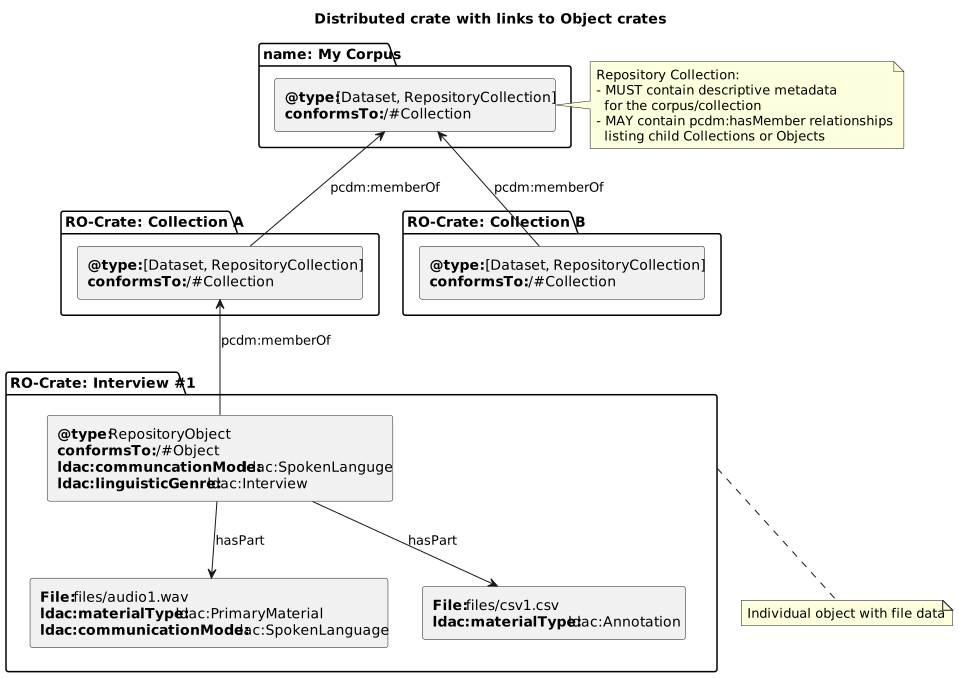
Property: Transcriber

Property Specialization Of Description Range Occurs in Domain(s)
ldac:transcriber https://w3id.org/ldac/terms#transcriber The participant produced a transcription of this or a related resource. Person, Organization Dataset

Property: Translator

Property Specialization Of Description Range Occurs in Domain(s)
ldac:translator https://w3id.org/ldac/terms#translator The participant produced a translation of this or a related resource. Person, Organization Dataset

Property: Usage Info

Property Specialization Of Description Range Occurs in Domain(s)
usageInfo http://schema.org/usageInfo Additional information on licensing options for using the data, e.g. 'Contact the Data Steward to discuss license terms'. Text Dataset

Property: Written Language Format

Property Specialization Of Description Range Occurs in Domain(s)
ldac:writtenLanguageFormat https://w3id.org/ldac/terms#writtenLanguageFormat The format of the resource resulting from the way the text was produced (handwritten, typeset, typewritten). Written Language Type Terms Creative Work